
Request a Diagnostic Conversation

FMCG and Consumers Products

Where Shelf Execution Breaks From the Plan

The route-to-market plan was agreed. Distribution targets were set, the promotional calendar was confirmed, and activation was signed off across distributors and retail partners.

Then a launch underperforms, not everywhere, in specific regions or outlet types, and nobody can say with confidence

whether the product wasn't distributed, wasn't available once it arrived, or simply wasn't in demand there.

Signal 1

Shipment on record, availability unclear

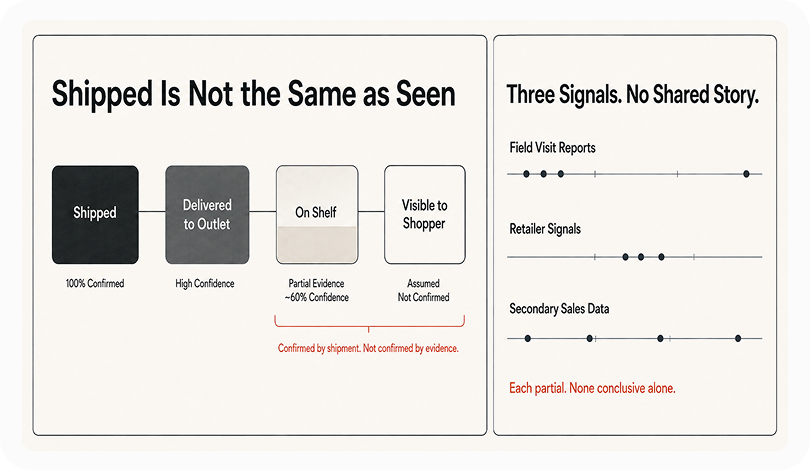
Shipment and invoicing data confirm the product entered the channel, but that alone doesn't confirm it reached the shelf or stayed available

Signal 2

An activation that didn't land

A planned promotional activation clearly didn't reach a meaningful share of stores, with no clear point of breakdown

Signal 3

The same gap, every quarter

The same execution issue recurs across launches without ever being traced to a likely cause

Signal 4

Signals that don't agree

Where field evidence, retailer signals, and secondary-sales data exist, they don't always tell the same story about actual availability

Leadership Question

When a launch underperforms at the shelf, can we tell whether it was a distribution gap, an activation failure, or genuine low demand?

What's Actually Breaking

The Plan Loses Fidelity Between HQ and the Outlet

A route-to-market plan is precise when it's built. As it moves through distributors and field teams to the individual outlet, variance enters at each stage, and it's rarely tracked systematically where.

Shipment Confirms Channel Entry, Not Shelf Presence

A SKU can be invoiced and shipped to an outlet, entering the channel, without that confirming it ever reached the shelf, stayed available, or was visible to a shopper. Those are three different facts, often treated as one.

Field Exceptions Get Resolved Locally, Then Disappear

A field rep fixes an out-of-stock or a planogram gap on a visit, the right instinct, but that fix and its cause rarely get logged anywhere leadership can see the pattern repeating elsewhere.

Request a Diagnostic Conversation

Why the obvious fix falls short

More Frequent Field Audits

Provides valuable point-in-time evidence, but misses what's happening on the shelf between visits.

Request a Diagnostic Conversation

A Bigger Distributor Scorecard

Measures distributor performance on invoicing and distribution, not whether the product is actually available to buy.

Trace the Plan to the Outlet

Give leadership visibility into where execution diverges from the route-to-market plan at each stage, distributor, field team, outlet.

Combine Available Signals on Availability

Bring together whatever combination of field evidence, retailer signals, and secondary-sales data exists to identify likely availability gaps, rather than relying on shipment data alone.

Surface Field Exceptions Centrally

Log local fixes centrally, what broke, who resolved it, so recurring patterns become visible instead of disappearing after each visit.

