
Request a Diagnostic Conversation

Healthcare Providers and Health System

When Staffing and Capacity Plans Stop Matching Patient

The staffing plan was built around expected volume, acuity, and skill mix. Capacity was allocated across departments, shifts were scheduled, and on paper the operation should run smoothly.

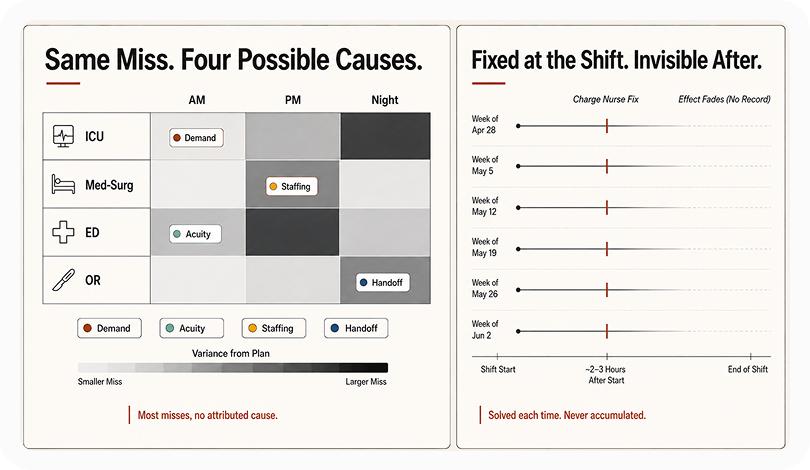
Then patient flow doesn't match the plan, not everywhere, in specific units or specific shifts, and it's often unclear whether the gap came from demand that exceeded the plan,

acuity that required a different skill mix than scheduled, a genuine staffing constraint, or a delay somewhere between departments.

Signal 1

Demand that outpaces the plan

Patient volume or acuity on a given shift exceeds what the staffing plan assumed

Signal 2

Acuity and skill mix mismatch

Patient acuity on a unit calls for a skill mix or credential level different from what was scheduled

Signal 3

Staffing constraints beyond the unit's control

Required credentialed staff are unavailable despite adequate overall headcount

Signal 4

Delays between departments

The same handoff or discharge delay recurs across reviews without a traced cause

Leadership Question

When a unit's throughput misses plan, can we distinguish whether the cause was patient demand, acuity, a staffing constraint, or a breakdown in a handoff?

What's Actually Breaking

The Plan Changes at Unit Level, but the Reasons Are Not Consistently Captured

A staffing and capacity plan is precise at the point it's built centrally. As it moves to department-level scheduling and shift assignment, it changes, sometimes because of demand, sometimes acuity, sometimes a credential gap, and the specific reason is rarely tracked systematically.

Local Adjustments Solve the Shift, Then Disappear

A charge nurse or unit lead reasonably adjusts staffing or flow in the moment. That adjustment and its underlying cause rarely become visible to leadership as a pattern, unless it's captured through the operational workflows already in place, rather than through additional manual reporting.

Departments Own Their Own Throughput, Not the Handoffs Between Them

Each department tracks its own metrics, ED, inpatient units, OR, discharge. Ownership of the handoff between departments, often where the real delay accumulates, is frequently unclear.

Request a Diagnostic Conversation

Why the obvious fix falls short

More Oversight Layers or Audits

Can improve visibility in the areas audited, but doesn't reveal whether a specific miss began with demand, acuity, staffing, or a handoff.

Request a Diagnostic Conversation

Blanket Staffing Increases

Addresses volume broadly, without necessarily addressing the specific point where flow is actually breaking down.

Trace the Plan to the Unit

Give leadership visibility into where staffing and flow diverge from plan at each stage, and whether the driver was demand, acuity, or staffing availability.

Assign Escalation Ownership and Response Expectations

When flow diverges materially, ensure there's a clear owner and expected response, captured through existing operational workflows wherever possible, not new manual reporting for frontline staff.

Surface the Gap While It's Still Small

Report material divergence between planned and actual flow early enough for operational response, not after it's already shaped a quarter's throughput numbers.

