
Request a Diagnostic Conversation

Financial Services

When Loan Growth Stops Translating Into Risk-Adjusted Return

Loan book growth is strong. Balances are up across products, and on paper the institution looks stronger than it did a year ago.

Then finance is asked what that growth actually did to risk-adjusted return, and the honest answer takes longer to reach than it should. Funding cost has moved.

Credit losses vary by product and vintage in ways not always reconciled with pricing. Whether growth is building durable earnings, or simply adding balance at a return leadership hasn't fully priced, isn't something that can currently be answered with confidence.

Signal 1

Balance growth, return unclear

Loan balances are climbing, with no reliable decomposition of what that means for risk-adjusted return by product

Signal 2

Cost of risk, reconciled inconsistently

Credit loss trends are tracked, but not always reconciled consistently against pricing, funding cost, capital, and operating cost in one product-level view

Signal 3

Funding cost, moving beneath the headline

Funding cost by product line shifts with rate and liquidity conditions, but its effect on margin isn't always isolated from other drivers

Signal 4

A quarter-end reconciliation

Risk-adjusted return figures for the board arrive later than the growth figures they're meant to explain

Leadership Question

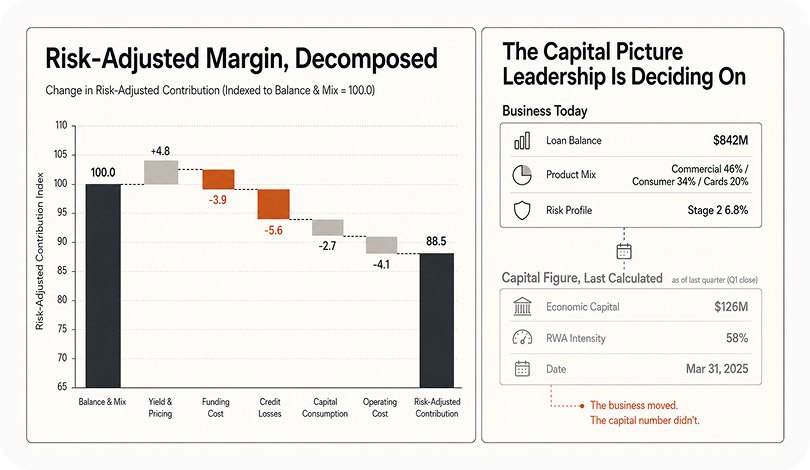
When risk-adjusted margin moves, can we say how much came from balance growth, pricing, funding cost, credit losses, or capital consumption, or only that it moved?

What's Actually Breaking

Risk-Adjusted Return Has No Agreed Decomposition

Balance, pricing, funding cost, credit losses, and capital consumption sit across core banking, treasury, risk platforms, and finance. Assembling them into one view of what a product actually returns, after funding and risk, is not always done consistently.

Cost of Risk Is Rarely Reconciled Alongside Pricing and Funding Cost

Credit losses are tracked, often carefully, but the real gap isn't visibility into losses alone, it's that they're not consistently reconciled with pricing, funding cost, capital, and operating cost in one product-level return view. Each piece gets analysed on its own.

Capital Allocation Lags the Business It's Meant to Reflect

Regulatory and economic capital figures by product are often calculated on a cycle slower than the business actually changes, so decisions get made on a capital picture that's already somewhat dated.

Request a Diagnostic Conversation

Why the obvious fix falls short

A Bigger Risk Dashboard

Shows balance, pricing, and loss figures clearly, but rarely decomposes margin movement into its actual product-level drivers.

Request a Diagnostic Conversation

Broadly Reducing Risk Appetite

Addresses risk broadly, without necessarily addressing the specific product, segment, or vintage where risk-adjusted return is actually weakest.

Decompose the Movement

Examine and reconcile each period's margin movement across balance and mix, yield and pricing, funding cost, credit losses, capital consumption, and operating cost, using agreed rules rather than siloed analysis.

Flag Where Attribution Relies on Assumption

This isn't a promise of complete certainty, it's a view of the most material return drivers with a clear flag on where attribution still depends on assumption.

Assign Accountability Before the Next Cycle

Accountability for improving the weakest inputs is clarified before the next reporting cycle.

