
Request a Diagnostic Conversation

Financial Services

When Digital Customer Journeys Depend on Invisible Manual Handoffs

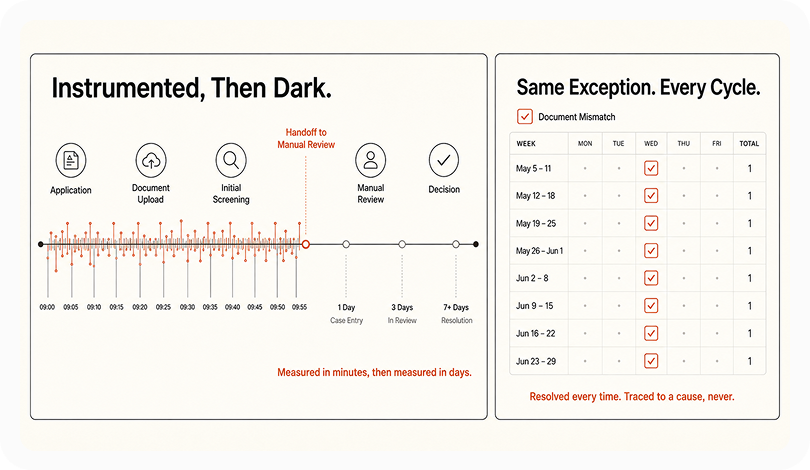
The digital account opening or lending journey looks fast and modern on the front end. Application, document upload, and initial screening may happen in minutes.

document upload, and initial screening may happen in minutes. Then a customer's journey stalls, not because the digital front end failed, but because it quietly handed off to a manual review, a KYC check, an AML flag, an underwriting exception, that nobody outside the operations team can see happening.

Leadership hears about the delay only when a customer complains or a metric moves, well after the moment it could have been caught.

Signal 1

A fast front end, an invisible back end

The digital journey is instrumented and measured closely. What happens once it hands off to manual review often isn't, at the same level of detail

Signal 2

Turnaround time that varies by reason nobody's tracked

Time-to-decision for a similar application varies significantly, and the specific control or exception causing the delay isn't always clear

Signal 3

The same exception, every review

The same type of manual exception, a document mismatch, a KYC flag, a servicing escalation, recurs without being traced to a root cause

Signal 4

A control satisfied, a customer still waiting

A compliance or risk control is completed correctly, but the customer-facing delay it caused doesn't get connected back to the control that caused it

Leadership Question

When a customer journey slows or fails, can leadership identify the exact control, handoff, or exception responsible?

What's Actually Breaking

The Digital Journey Is Measured, the Manual Handoff Isn't

Front-end journey analytics track every digital step in detail. Once a case moves to manual KYC review, AML escalation, or underwriting exception, visibility often drops to a queue and a resolution date, without the same granularity on why it stalled or how long each stage actually took.

Exceptions Get Resolved Individually, Rarely Traced to a Root Cause

An operations team resolves a KYC mismatch or an underwriting exception case by case, which is the right instinct. Whether that exception type recurs because of a specific document requirement, a data quality issue, or an unclear escalation path is inconsistently tracked back to its source.

Ownership of the Handoff Is Often Unclear

The digital team owns the front-end journey. Operations owns the manual review. Ownership of the handoff between them, where a case can sit unassigned or unclear on next steps, is frequently nobody's explicit responsibility.

Request a Diagnostic Conversation

Why the obvious fix falls short

A Bigger Case Management Dashboard

Shows case volume and aging clearly, but rarely reveals which specific control or handoff is generating the delay. Shows case volume and aging clearly, but rarely reveals which specific control or handoff is generating the delay.

Request a Diagnostic Conversation

Adding More Operations Headcount

Can reduce a backlog temporarily, without addressing the specific control or handoff generating the exceptions in the first place.

Trace the Journey Through Every Handoff

Give leadership visibility into the digital journey and the manual review stages it hands off to, at the same level of detail, not just the digital front end.

Assign Escalation Ownership and Response Expectations

Ensure every handoff, KYC review, AML escalation, underwriting exception, has a clear owner and expected turnaround, captured through existing case management workflows wherever possible.

Surface the Gap While It's Still Small

Report material turnaround delays and recurring exception types early enough for operational response, not after a customer complaint or a metric shift.

