
Request a Diagnostic Conversation

Retail

When Connected Systems Still Cannot Support a Connected Decision

The data investment has been real.

Dashboards exist for sales, inventory, stores, and customers. Reports arrive on schedule, and by most measures, the retailer is more instrumented than it was before the latest wave of data investment.

Yet leadership still hesitates before a major decision, asking whether the numbers in front of them reflect what's actually happening now, or just what happened last time the systems were reconciled. More dashboards haven't closed that gap. Data may be moving between systems. The decision still lacks one governed and dependable answer.

Signal 1

More views, same doubt

New dashboards get built regularly, but leadership still asks whether they can be trusted before a major decision

Signal 2

Confirmation, not the decisions that matter

Reports reliably confirm what already happened. They rarely support decisions that cut across functions, look forward, or hinge on an exception

Signal 3

A request for one more report

Leadership's response to an unclear signal is usually to ask for another report, rather than to question the architecture producing all of them

Signal 4

Definitions that don't actually match

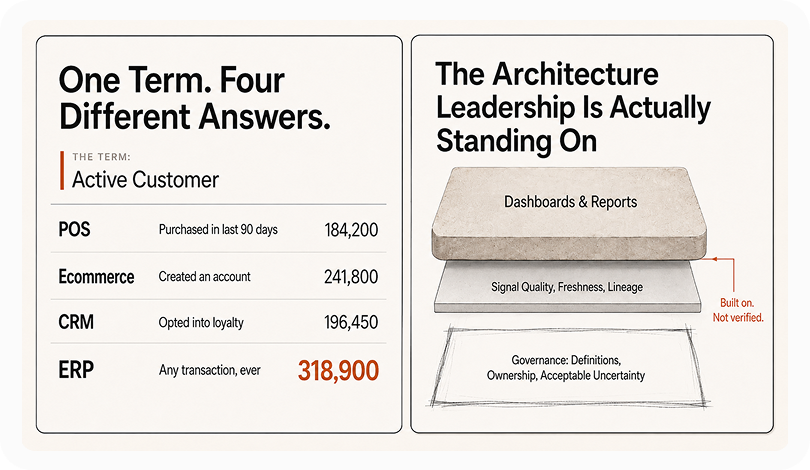
Terms leadership assumes are shared, net sales, availability, active customer, a fulfilled order, turn out to mean something different from one system or team to the next

Leadership Question

If we built this exact dashboard again next year, would it actually answer the question we can't currently answer, or would it just look better while still failing to answer it?

What's Actually Breaking

The Architecture Was Built Around Available Systems, Not Leadership Questions

Most retail data investment connects the systems that already exist, POS, ERP, ecommerce, CRM. That's necessary, but it means the architecture answers what those systems can report, not necessarily what leadership needs to decide.

Signal Quality Gets Assumed, Not Verified

Dashboards get built on the assumption that if a number exists, it's reliable enough to act on. Quality, freshness, and lineage rarely get checked against a defined threshold, and even more rarely monitored on an ongoing basis once the dashboard ships.

Governance Arrives After the Architecture, Not Before It

Access controls typically get addressed once a platform is already live. Definitions, quality ownership, lineage, approved use, and what level of uncertainty is acceptable for a given decision rarely get designed in from the start, and retrofitting them afterward is slower and more disruptive than deciding them upfront.

Request a Diagnostic Conversation

Why the obvious fix falls short

Adding More Dashboards

Produces more views of data whose underlying reliability was never verified. More views don't create more trust.

Request a Diagnostic Conversation

A Full Platform Replacement

Can be justified on its own merits, but without first verifying signal quality and governance, it moves the same unverified data into a newer, more expensive system.

Start From the Decision, Not the System

Identify the specific leadership decisions the architecture actually needs to support, before deciding which systems to connect or how.

Verify Signal Quality Before Building On It

Test whether the underlying data meets a defined bar for quality, freshness, and lineage, and whether that bar is monitored continuously, before a dashboard or model gets built on top of it.

Design Governance In, Not Around

Set definitions, quality ownership, lineage, approved use, and acceptable uncertainty as part of the architecture from the start, not as access controls retrofitted after something goes live.

