
Request a Diagnostic Conversation

Manufacturing

When the Production Plan and the Shop Floor Stop Matching

The production schedule was agreed. Line assignments, material availability, and shift plans were confirmed, and on paper the plant should hit its output target.

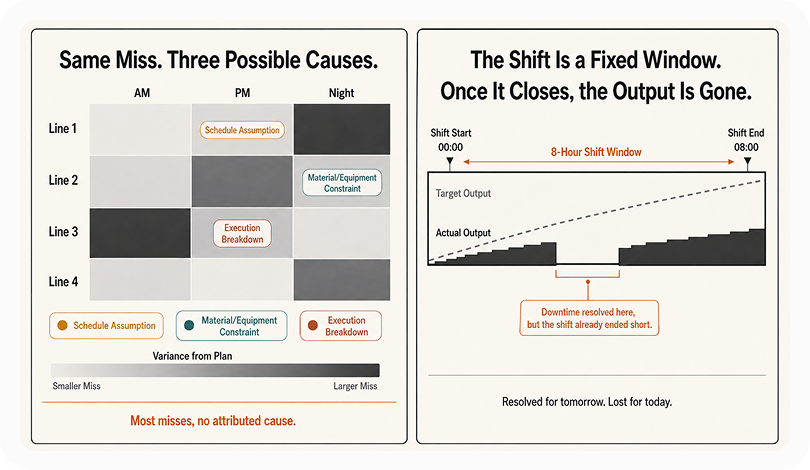
Then output doesn't match the plan, not on every line, on specific runs or specific shifts, and it's often unclear whether the gap came from the plan's own assumptions,

a genuine material or equipment constraint, or a breakdown somewhere in execution.

Signal 1

Wide variance, similar schedules

Output varies significantly across shifts with similar staffing and material plans

Signal 2

Downtime with no clear owner

A line goes down, and it's not always clear whether the cause was a scheduled changeover running long, a material shortage, or an equipment failure

Signal 3

The same stoppage, every review

The same type of downtime, a specific changeover, a specific equipment fault, recurs without being traced to a root cause

Signal 4

Resolution after the shift is lost

Downtime gets resolved, but usually after the shift's output target has already been missed

Leadership Question

When a line misses its output target, can we distinguish whether the cause was the schedule's assumption, a material or equipment constraint, or a breakdown in execution?

What's Actually Breaking

The Schedule Changes as the Shift Runs, But the Reasons Aren't Consistently Captured

A production schedule is precise when it's built. As the shift actually runs, with changeovers, material delays, and equipment condition all shaping the outcome, it changes, sometimes for good operational reasons, and the specific reason is rarely tracked systematically.

Local Adjustments Solve the Shift, Then Disappear

A line supervisor reasonably re-sequences a run or works around a material shortage. That adjustment and its underlying cause rarely become visible to leadership as a pattern, unless it's captured through the operational workflows already in place.

Maintenance and Production Own Their Own Function, Not the Handoff Between Them

Maintenance tracks equipment condition and repairs. Production tracks output and schedule adherence. Ownership of the handoff between them, where a downtime cause often actually originates, is frequently unclear.

Request a Diagnostic Conversation

Why the obvious fix falls short

More Frequent Line Audits

Provides valuable point-in-time evidence, but not continuous visibility into where execution is diverging right now, on shifts not being audited.

Request a Diagnostic Conversation

Blanket Preventive Maintenance Increases

Can reduce some downtime broadly, without necessarily addressing the specific line or cause where downtime is actually concentrated.

Trace the Schedule to the Shift

Give leadership visibility into where execution diverges from the production schedule at each stage, and whether the driver was the schedule, materials, equipment, or execution.

Assign Escalation Ownership and Response Expectations

When output diverges materially, ensure there's a clear owner and expected response, captured through existing shop floor workflows wherever possible.

Surface the Gap While It's Still Small

Report material schedule-versus-actual divergence early enough for operational response, not after the shift's output has already been lost.

