
Request a Diagnostic Conversation

Healthcare Providers and Health System

When Clinical and Financial Systems Can’t Answer the Same Question

The data investment has been real. The EHR, billing systems, and claims platforms all exist, and each supports its own operational purpose and reporting logic.

But definitions, timing, and reporting logic don't always align across them for the cross-functional decisions leadership actually needs to make.

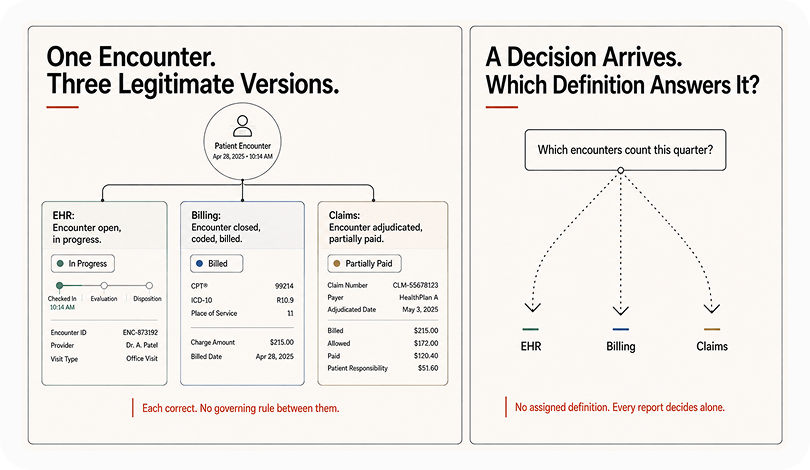
A patient encounter looks different in the EHR than it does in billing, and different again in a payer's claims record, each legitimately, for its own purpose. Leadership isn't just short of data, it's short of a shared way to decide which definition should govern which decision.

Signal 1

One encounter, several versions

The same patient encounter is represented differently across the EHR, billing, and claims systems, each valid for its own purpose, but rarely reconciled

Signal 2

Confirmation, not the decisions that matter

Reports reliably confirm what already happened financially or clinically. They rarely support decisions that cut across both, or that look forward

Signal 3

No agreed logic for which definition governs

When a decision spans clinical and financial data, there's no established rule for which system's definition of an encounter should be used, so each report resolves it differently

Signal 4

Compliance and access questions arriving late

Authorised use, minimum necessary access, and data lineage questions are often addressed once a system is already live, rather than designed in from the start

Leadership Question

Before adding another system or report, can leadership confirm which definition of an encounter should govern this specific decision?

What's Actually Breaking

The Architecture Was Built Around Available Systems, Not Leadership Questions

Most healthcare data investment connects the systems that already exist, EHR, billing, scheduling, claims. That's necessary, but it means the architecture answers what those systems can report individually, not necessarily the cross-functional questions leadership actually needs answered.

Clinical, Operational, and Financial Definitions Are Each Valid, But Rarely Reconciled

An encounter, episode, or completed case can legitimately mean something different depending on whether it's viewed clinically, operationally, or financially. The problem isn't that one of these definitions is wrong, it's that the organisation may not have an agreed map of which definition should govern which leadership decision.

Governance Arrives After the Architecture, Not Before It

Access controls typically get addressed once a platform is live. Authorised use, minimum necessary access, data ownership, lineage, auditability, and continuing compliance monitoring rarely get designed in from the start, and healthcare's regulatory requirements make retrofitting this slower and riskier than deciding it upfront.

Request a Diagnostic Conversation

Why the obvious fix falls short

Adding More Reporting Dashboards

Produces more views of data that may still be using unreconciled definitions of the same clinical and financial events.

Request a Diagnostic Conversation

A Full EHR or Platform Replacement

Can be justified on its own merits, but without first reconciling which definitions govern which decisions, it moves the same unresolved mismatches into a newer, costlier system.

Map Which Definition Governs Each Decision

Establish where clinical, operational, and financial definitions of an encounter legitimately differ, then define which meaning applies to which leadership decision, rather than forcing one universal definition.

Verify Signal Quality Before Building On It

est whether the underlying data meets a defined bar for quality, freshness, and lineage, monitored continuously, before anything gets built on top of it.

Design Governance In, Not Around

Set authorised use, minimum necessary access, data ownership, lineage, auditability, and continuing compliance as part of the architecture from the start.

