
Request a Diagnostic Conversation

FMCG and Consumers Products

When Every Partner Describes the Same Product Differently

The data investment has been real. ERP, trade promotion systems, distributor portals, and syndicated market data all exist, and each reports reliably on its own terms.

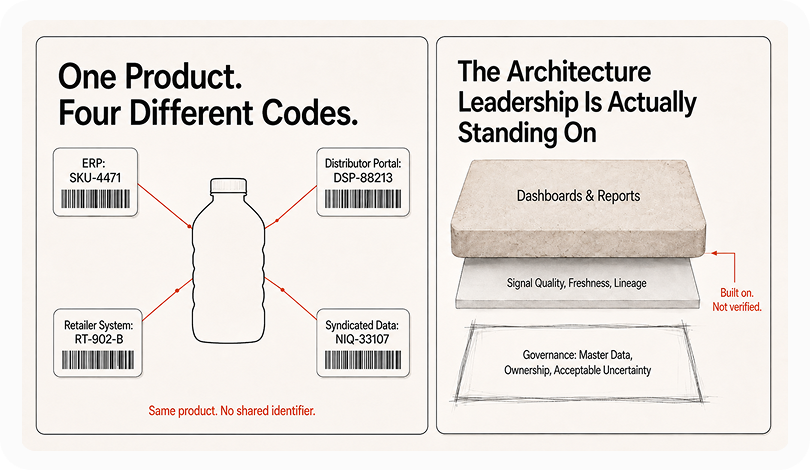
But those terms rarely agree. A single SKU can carry different identifiers across the manufacturer's own systems, each distributor, each retailer, and the syndicated data provider tracking the category.

The same is true for outlets and customers. Leadership isn't just short of data, it's short of a shared way to describe what the data is actually about.

Signal 1

One product, several identities

The same SKU is coded differently across internal systems, distributors, retailers, and syndicated data providers, making it hard to confirm they're describing the same product

Signal 2

Outlets that don't match either

Retail outlet and customer records rarely align across a manufacturer's own systems and its distributor or retail partners' systems

Signal 3

Confirmation, not the decisions that matter

Reports reliably confirm last cycle's sell-in and sell-out. They rarely support decisions that are forward-looking or cut across brand and commercial teams

Signal 4

A request for one more data feed

The response to an unclear signal is usually to add another data source, rather than question whether the existing ones can even be reconciled

Leadership Question

Before adding another data source, can leadership confirm that today's sources are even describing the same products, outlets, and customers?

What's Actually Breaking

Product, Outlet, and Customer Hierarchies Don't Match Across Partners

A manufacturer's product, outlet, and customer hierarchies rarely match those used by distributors, retailers, and syndicated data providers. Without reconciled identifiers, combining their data means combining records that may not actually refer to the same thing.

Signal Quality Gets Assumed, Not Verified

Distributor and syndicated data get built into dashboards on the assumption that if a number exists, it's reliable enough to act on. Quality, freshness, and lineage rarely get checked against a defined threshold, or monitored once the dashboard is live.

Governance Arrives After the Architecture, Not Before It

Access controls typically get addressed once a platform is live. Master data ownership, identifier reconciliation, and what level of uncertainty is acceptable for a given decision rarely get designed in from the start.

Request a Diagnostic Conversation

Why the obvious fix falls short

Adding More Data Sources

Produces more views of data that may not even be describing the same products or outlets as the sources already in place.

Request a Diagnostic Conversation

A Full Platform Replacement

Can be justified on its own merits, but without first reconciling identifiers and verifying signal quality, it moves the same unresolved mismatches into a newer, costlier system.

Reconcile Product, Outlet, and Customer Identifiers

Establish a master mapping across manufacturer, distributor, retailer, and syndicated-data identifiers before combining their numbers into one view.

Verify Signal Quality Before Building On It

Test whether the underlying data meets a defined bar for quality, freshness, and lineage, monitored continuously, before anything gets built on top of it.

Design Governance In, Not Around

Set master-data ownership, identifier reconciliation, and acceptable uncertainty as part of the architecture from the start.

